A significant portion of Clarke County is positioned to become an Opportunity Zone following approval by Iowa Governor Kim Reynolds and the Iowa Economic Development Authority (IEDA) of Clarke County Census Tract 9603 for the state’s Opportunity Zone 2.0 nomination.
The tract encompasses essentially all of Clarke County west of Interstate 35 – more than 220 square miles – including areas identified for several of the county’s significant future development opportunities.
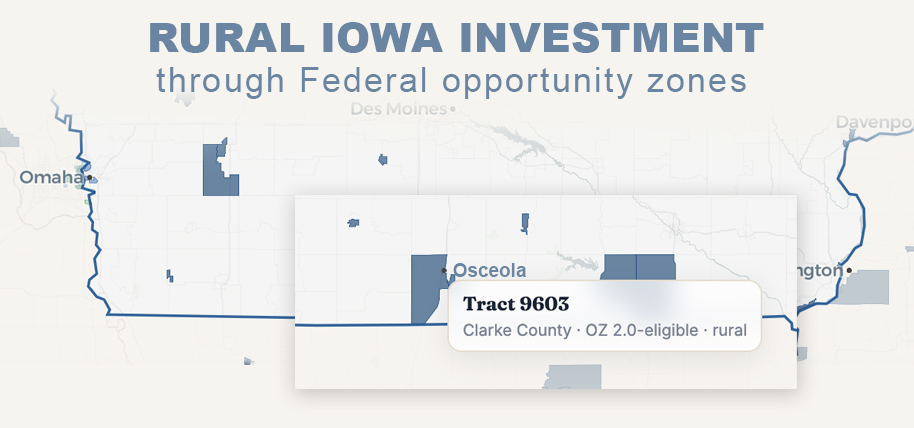
For Clarke County, the designation represents something more than another source of funding. An Opportunity Zone does not create a pool of public money to distribute to projects. Instead, it creates a framework designed to attract private investment into the designated area.
“Opportunity Zone designation gives us another tool in our economic development playbook,” said Andrew Clark, Executive Director of the Clarke County Development Corporation. “This is not creating a pool of money. It’s creating a mechanism to attract money. The real opportunity is using this designation to bring new private investment into Clarke County and help make larger, more impactful projects possible.”
As part of the application process, local economic development partners identified several potential projects that could benefit from Opportunity Zone investment, including the long-term Clarke County Reservoir project, future development at the E. Eddy Saylor Business Park, potential housing development and other commercial, industrial and community development opportunities.
The federal Opportunity Zone program is designed to encourage long-term private investment in designated communities. Investors can place eligible capital gains into Qualified Opportunity Funds, which can then invest in qualifying businesses and property within designated Opportunity Zones. Qualifying investors may receive federal tax benefits associated with those investments.
In 2025, Congress made the federal Opportunity Zone tax incentive permanent through the One Big Beautiful Bill Act, creating what is commonly referred to as “Opportunity Zones 2.0.” The updated program establishes new Opportunity Zone designations on a 10-year cycle beginning in 2027 and provides enhanced incentives for certain investments in rural Opportunity Zones.
For Clarke County, that rural emphasis is particularly relevant as the community looks to attract private investment for growing infrastructure, housing, industrial and commercial development.
The community and region are already pursuing projects that could require significant capital investment. The proposed Clarke County Reservoir represents a long-term investment in regional water capacity and future growth. The E. Eddy Saylor Business Park provides opportunities for additional industrial and commercial development, while housing initiatives can help create the residential capacity needed to support workforce and population growth being realized across the county.
Opportunity Zone designation doesn’t fund those projects. It can, however, make them more attractive to investors. That distinction is particularly important for projects that may be large, complex or capital-intensive to be addressed through traditional grants or local resources alone.
“Some projects are simply bigger than a traditional grant program,” Clark said. “If we’re talking about significant infrastructure, industrial development, housing or mixed-use investment, we need to think differently about how we finance those opportunities. Opportunity Zone designation gives us another mechanism to bring private capital to the table.”
CCDC intends to view the designated area as part of a broader investment strategy for Clarke County rather than as a single development site or one-time funding opportunity.
While state approval represents an important milestone, additional federal steps remain before the new Opportunity Zone designation becomes effective. HUD currently anticipates that the first Opportunity Zone 2.0 designations will become effective January 1, 2027.
CCDC will continue working with local leadership, property owners, developers, businesses and potential investors to identify projects that may benefit from the designation and connect those opportunities with appropriate investment partners.
For more information on the Opportunity Zone designation or additional questions regarding development in Clarke County, Iowa, please contact Andrew B. Clark at the Clarke County Development Corporation: 115 E Washington Street, Osceola, IA 50213 phone: 641-342-2944 or email info@clarkecountyiowa.com



